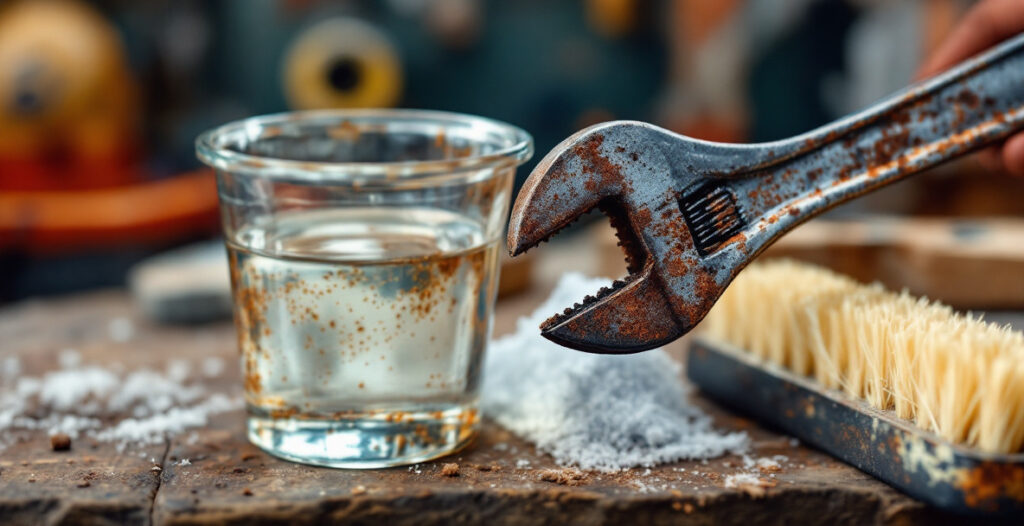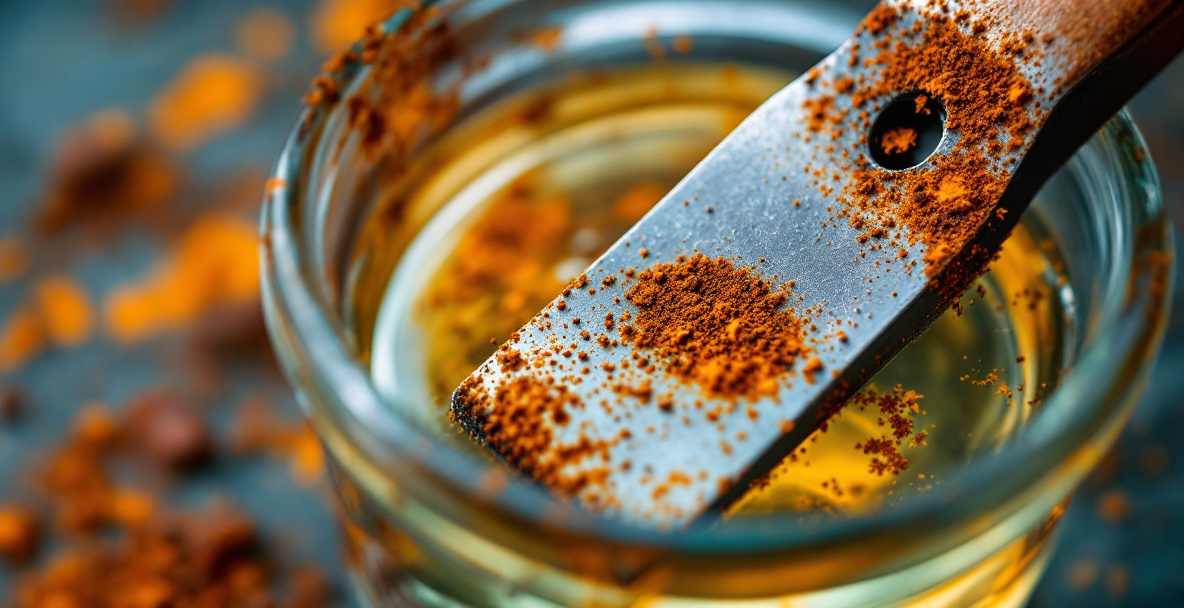
Soak times for white vinegar rust removal depend on the metal and how bad the rust is: light surface rust on plain high-carbon steel (chisels, plane irons, saw plates) usually clears in 4 to 8 hours. Heavier, flaky rust needs 12 to 24 hours. Cast iron tool bodies (plane soles, vise jaws) tend to need the longer end of that range, 12 to 24 hours, and should be checked every few hours so the acid doesn’t start etching the surface once the rust is gone.
White vinegar works because it’s a dilute acetic acid solution, typically around 5%. That acid dissolves iron oxide (rust) without needing much scrubbing, which is why it’s a popular choice for anyone restoring secondhand tools on a budget. But “soak it in vinegar” isn’t a one-size-fits-all instruction — a thin saw blade and a chunky cast iron plane sole do not behave the same way in the same tank, and if you treat them the same, you’ll either under-soak one or pit the other.
How does white vinegar remove rust from tools?
Acetic acid reacts with iron oxide and converts it into soluble iron acetate, which lifts off the metal surface and into the liquid. That’s the whole mechanism — no scrubbing required to start the reaction, though scrubbing helps clear loosened rust faster.
The acid doesn’t distinguish between rust and bare metal once the rust layer is gone. That’s the catch. Leave a tool soaking too long after it’s already clean, and the vinegar will start to etch the base metal, leaving a dull, slightly pitted gray surface instead of bright steel. This is the main reason soak time matters more than concentration — full-strength white vinegar (5% acetic acid) from the grocery store is already strong enough for this job. Diluting it further just slows things down for no benefit.
Does the type of metal change the soak time?
Yes — soak time depends heavily on the metal’s density, surface area, and how it was originally hardened. High-carbon tool steel reacts faster and needs closer watching than cast iron, which is more porous and takes longer for the acid to fully penetrate rust pits.
Container choice also plays a role that’s easy to overlook. Plastic bins, glass dishes, and food-safe buckets are all fine; avoid anything metal, since the vinegar will react with the container itself and you’ll lose track of how much acid is actually working on your tool. Use a container just big enough to submerge the piece — a huge volume of vinegar doesn’t speed things up, it just means you’re buying more vinegar than you need. If you’re treating several tools at once, separate soaks are safer than one shared tank, because a heavily rusted piece will exhaust the vinegar’s effectiveness faster and throw off the timing for everything else sharing that liquid.
Soak times for high-carbon steel (chisels, plane irons, hand saws)
Light, surface-level rust on high-carbon steel usually clears in 4 to 8 hours. This covers most chisels and plane irons that have sat in a damp shed or garage for a season or two — orange discoloration without deep pitting.
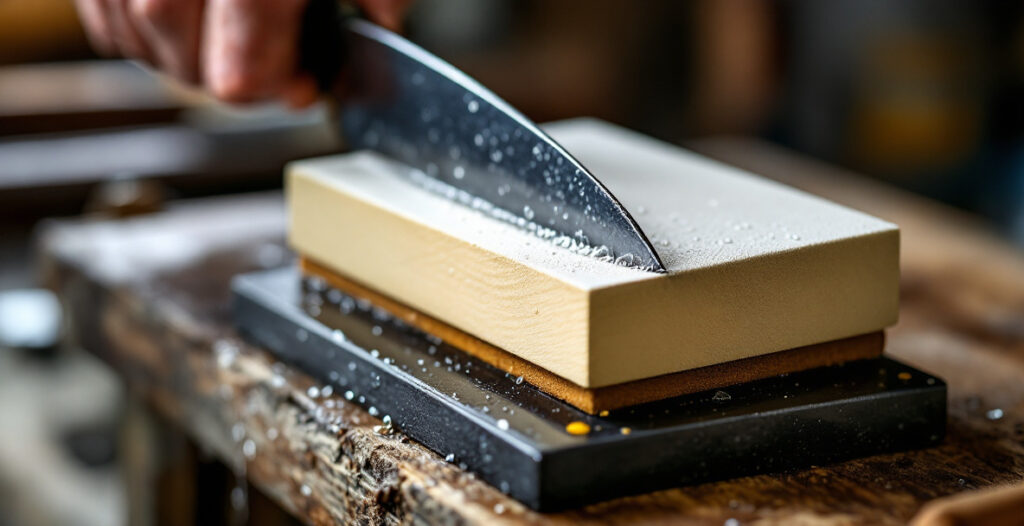
Heavier rust, the kind with flaking or a rough, scaly texture, needs 12 to 24 hours. Check the tool every 4 hours or so once you pass the 8-hour mark. High-carbon steel is thin relative to its surface area on an edge tool, so it reacts quickly, and leaving it too long risks etching the cutting edge geometry you’ll need to re-establish anyway when you sharpen it. If you’re restoring a chisel edge after derusting, our how to sharpen a hand plane blade guide covers getting a secondhand edge back to usable without fancy gear.
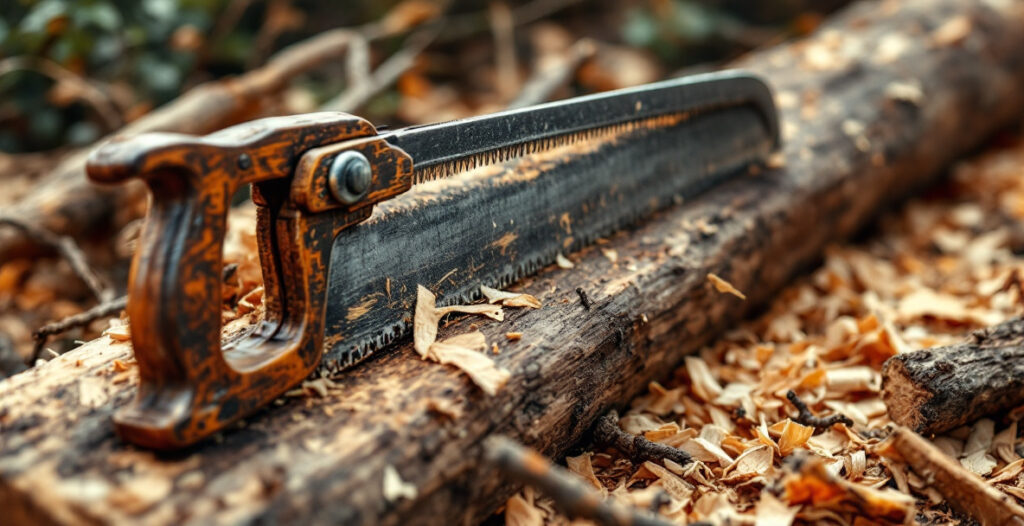
Thin blades — hand saw plates, dovetail saw backs — sit at the fast end of this range. Check them at the 4-hour mark first. A saw plate left in vinegar overnight when it only needed 4 hours will often come out with a visibly duller, grayer finish than it went in with.
Soak times for cast iron (plane soles, vise bodies, machine tables)
Cast iron typically needs 12 to 24 hours, sometimes longer for deeply pitted surfaces. Cast iron is more porous than forged steel, so rust can work its way slightly below the visible surface, and the vinegar needs more time to reach it.
Check a cast iron plane sole every 6 hours after the first 12. Pull it out, wipe it down, and look at the color. Fresh rust still visible means it goes back in. A grayish, slightly rough but rust-free surface means it’s done — further soaking won’t help and will start etching the iron itself.
One practical note specific to cast iron: flash rust appears almost immediately once you pull the piece out of the vinegar and it hits open air, because the surface is now bare and reactive. Have your neutralizing rinse (plain water, or a quick baking soda wipe) and oil ready before you start the soak, not after.
Large flat surfaces, like a table saw table or a jointer bed, pose a different problem: full submersion often isn’t practical. In these cases, soaked rags or paper towels laid directly on the rusted areas and kept wet with vinegar for the same 12 to 24 hour window work almost as well as a full soak, as long as you keep checking that they haven’t dried out partway through. Covering the rags with plastic sheeting slows evaporation and keeps the acid working longer between checks.
Soak times for mild steel (brackets, fasteners, non-tool-steel parts)
Mild steel generally needs 6 to 12 hours for moderate rust. It’s less dense than high-carbon tool steel and rusts faster to begin with, but it also responds to vinegar more predictably since there’s less concern about disturbing a hardened cutting edge.
This category covers things like rusted bolts, hinges, and bracket hardware you might pull off an old piece of furniture or salvage from a flea market find. There’s generally more margin for error here than with edge tools — a little over-soaking on a bolt isn’t going to ruin its function the way it would a chisel’s edge.
Threaded fasteners deserve one extra bit of attention: rust inside the threads themselves can make nuts and bolts seize even after the visible surface rust is gone. For these, a light wire-brush pass down the threads after the soak, before oiling, clears out anything the vinegar loosened but didn’t fully dissolve, and it’s much easier to do while the metal is still slightly damp than once it’s dried and re-oiled.
What’s the full process once the soak time is up?
Pull the tool, rinse it in plain water to stop the acid reaction, then scrub off any loosened rust with a stiff brush, steel wool, or fine abrasive pad. Dry it immediately and completely — vinegar-treated steel flash-rusts fast if left wet, often within minutes.
After drying, apply a light coat of oil right away. This is non-negotiable: bare steel straight out of a vinegar soak is more reactive than it was before you started, because the protective oxide layer and any old oil film are both gone. Mineral oil, camellia oil, or plain machine oil all work. For the full soak-and-scrub sequence step by step, see the white vinegar soak and scrub method.
If a tool still has stubborn rust in pits after a full soak cycle, don’t just keep adding vinegar time. At that point abrasion does the rest of the work more efficiently — see sanding and abrasive rust removal methods for finishing off the spots vinegar alone won’t shift.
Is white vinegar always the right choice for rust removal?
No. Vinegar is cheap, safe to use indoors, and effective on moderate rust, but it’s slow and not ideal for heavily pitted or badly corroded tools where abrasion or electrolysis will get you a usable edge faster. For a comparison of vinegar against other approaches, including when they’re the better call, see four rust removal methods beyond vinegar.
Several woodworkers and tool restorers report similar soak-time ranges from direct experience with old hand tools — one practical rundown of the method is in Youtube. A thread of hobbyist machinists discussing results and soak lengths is also worth reading if you want more anecdotal data points: Hobby Machinist.
How do you know when a tool has soaked too long?
Over-soaked steel looks dull gray rather than bright, and feels slightly rough or etched rather than smooth under a fingernail. If this happens, it’s not usually a disaster — a few minutes with fine sandpaper or steel wool typically restores the surface, but it’s extra work you can avoid by checking sooner.
Frequently asked questions
Can I speed up vinegar rust removal?
Warming the vinegar slightly (not boiling it) speeds the reaction somewhat, as does agitating or scrubbing periodically during the soak rather than leaving the tool completely undisturbed. Neither shortcut is dramatic — vinegar is a slow method by nature, and that’s the trade-off for it being cheap and safe.
Will vinegar damage the wooden handle on a tool?
Extended soaking can dry out or discolor wood, so submerge only the metal part where possible. For tools with fixed wooden handles, prop the tool so the metal sits in the vinegar and the handle stays above the liquid line, or wrap the handle in plastic.
Is it safe to reuse the same vinegar for multiple soaks?
Yes, as long as it still smells strongly acidic and hasn’t turned thick or sludgy with dissolved rust. Once it’s saturated with iron acetate, it loses effectiveness and soak times will stretch out noticeably — at that point, replace it.
Does the vinegar need to be heated or diluted?
No. Plain white vinegar at standard grocery-store strength (around 5% acetic acid) works as-is. Dilution slows the reaction without any real benefit, and heating isn’t necessary — it just shaves a bit of time off a process that isn’t urgent to begin with.
What should I do immediately after the soak before storing the tool?
Rinse, dry completely, and oil the bare metal right away. Skipping any of these three steps — especially drying — undoes most of the benefit of the soak, since bare steel rusts again within hours in a damp shed or garage.