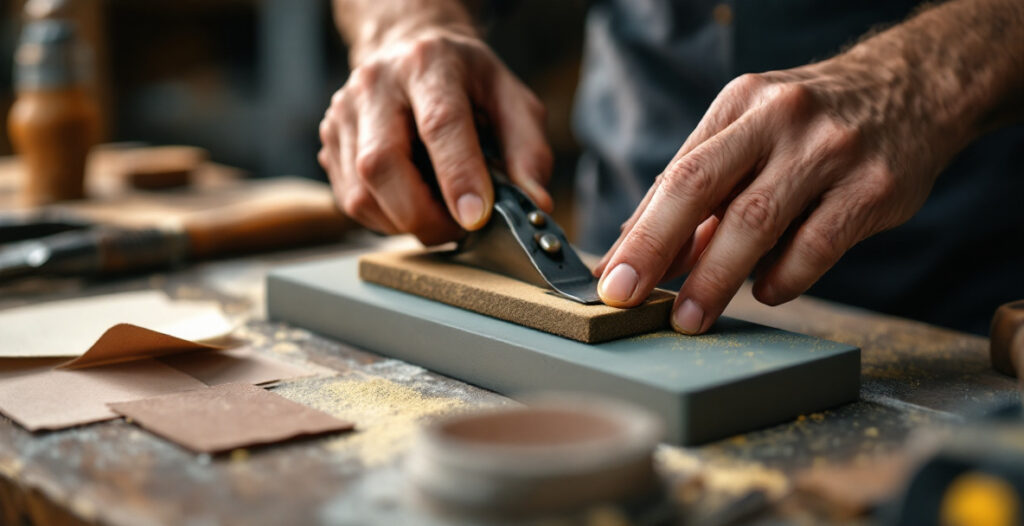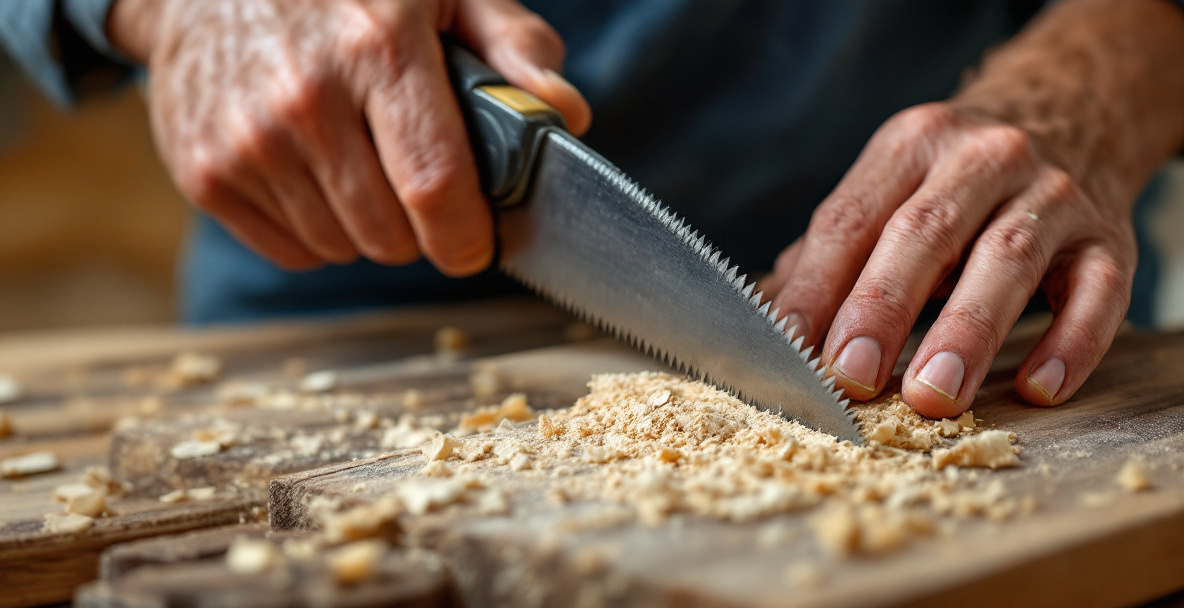
A coping saw is used by cutting along the waste side of a marked line with the blade held perpendicular to the work, letting the thin, narrow blade turn to follow curves that a wider saw cannot. It excels at coping the profile of one moulding to fit against another, cutting dovetail waste, and shaping curved parts like chair seats or bracket feet. The blade is disposable and cheap, so replace it often rather than fight a dull one.
What is a coping saw actually good for?
A coping saw is a thin-bladed frame saw built for cutting curves, tight internal corners, and removing waste between dovetail pins and tails. The frame holds a narrow, replaceable blade under tension, and because the blade is so thin, it can turn corners a handsaw or panel saw simply cannot manage.
It is not a saw for long straight cuts or thick stock. Use it for the fussy work: coping skirting board joints, cutting the curved profile in a stool seat, clearing waste from a mortise, or shaping a cabriole leg roughed out with other tools. If you only own one specialty saw in a small shop, this is a strong candidate, because it does jobs no other hand saw does well.
How is it different from a fret saw or scroll saw?
A fret saw has a deeper frame and a finer blade for delicate, decorative fretwork in thin material. A scroll saw is a powered machine doing similar work faster and with less control. A coping saw sits between them: sturdier than a fret saw, slower and quieter than a scroll saw, and better suited to furniture-scale joinery than either.
How do you set up a coping saw before cutting?
Setup means installing the blade with teeth pointing the right way and tensioning the frame so the blade stays rigid under load. Get this wrong and the blade will wander, bind, or snap within the first few strokes.
Which way should the teeth face?
Most woodworkers install the blade with teeth pointing toward the handle, so the saw cuts on the pull stroke. This is the opposite of most Western handsaws. It matters because a coping saw’s thin frame buckles less under a pull stroke than a push stroke, and buckling is exactly what causes wandering cuts. If you find yourself pushing hard and the blade still won’t bite, check the teeth direction before you assume the blade is dull.
Some coping saw work, particularly cutting dovetail waste while the workpiece is held vertically in a vise, is easier with the blade facing the other way so it cuts on the push. Either orientation is correct as long as it matches how you’re holding the work. Pick one, stay consistent, and you’ll develop a feel for it faster.
How tight should the blade be?
Tight enough that plucking the blade gives a clear, high-pitched note, similar to a guitar string. A loose blade flexes sideways mid-cut and drifts off your line, which is the single most common complaint beginners have with coping saws. Most frames have a wing nut or a turning handle at the back for this — give it a firm quarter turn past hand-tight and check the blade doesn’t twist in the clamps as you tension it.
How to use a coping saw: the basic cutting technique
Hold the saw with the frame above or to the side of the cut, keep the blade square to the work, and let the saw’s own weight and a light pull stroke do the cutting rather than forcing it. Rushing the stroke is what snaps blades, not the wood.
Start the cut with the blade resting on the line at a shallow angle, almost skating across the surface, then bring it upright once a shallow groove is established. Use short, even strokes rather than long, sawing motions — a coping saw’s blade is only a few inches long, so a stroke that’s too long wastes effort and increases the chance of the blade flexing out of true.
To cut a curve, turn the workpiece rather than twisting the saw. The frame of a coping saw is wide, and trying to steer a tight curve by twisting the frame itself will bend the blade instead of turning the cut. Rotate the wood in the vise as you go, keeping the blade traveling in a straight line relative to your body even as the cut curves.
Cutting internal corners and tight radii
For a sharp internal corner, like the inside of a bracket foot, cut two separate lines that meet at the corner rather than trying to turn the blade through 90 degrees in one pass. The blade will snap or bind if you force a turn that’s tighter than its width allows. Two straight-ish approaches meeting at a point produce a cleaner, more controlled result than one heroic curved cut.
Coping a moulding joint
Coping a joint means cutting the end of one moulding to the exact negative profile of the piece it’s butting against, so the two appear mitred without an actual mitre. Cut a 45-degree mitre first to reveal the profile’s outline on the end grain, then follow that outline with the coping saw, angling the blade back slightly (undercutting) so only the front edge of the profile makes contact. This is genuinely fiddly the first few times. Expect to waste a couple of offcuts learning the undercut angle before it clicks.
What blade should you use for different cuts?
Blade choice comes down to teeth-per-inch (TPI): more teeth for thin, fine work and controlled curves, fewer teeth for faster, rougher cuts in thicker stock. A typical coping saw blade runs somewhere around 15-20 TPI, which is fine enough for most furniture joinery and moulding work.
Buy several blades at once, because they are the wear part of the tool and they will snap, usually at the worst moment mid-cut. There’s no shame in this and no fixing a snapped blade — replace it and carry on. Given how cheap coping saw blades are secondhand or new, there’s little reason to nurse a dull one through a project when a fresh blade will cut faster and straighter.
Why does the blade keep snapping?
Blades snap almost always because of side-loading — twisting the frame to steer a curve instead of turning the workpiece — or because the blade was under-tensioned and flexed too far before it broke. Both are technique issues, not bad luck, and both are fixable.
Forcing the saw through a cut that’s binding is the other common cause. If the blade stops advancing and you find yourself pushing harder, stop and back the blade out rather than forcing it. Binding usually means the kerf has closed slightly because the wood is under tension, or the blade has drifted off square. A demonstration of the pull-stroke technique and blade tensioning in real time is worth watching once if you learn better visually than from text — this coping saw tutorial covers the same setup and stroke fundamentals described above.
Where does a coping saw fit into hand tool joinery?
A coping saw is a finishing and clean-up tool, not a stock-removal one — it’s what you reach for after rougher tools have done the bulk of the work, to clear waste and true up curves and corners. In dovetailing, for example, you saw the pins and tails with a dovetail saw, then use the coping saw to remove the bulk of the waste between them before paring to the line with a chisel. Trying to skip straight to the coping saw for the whole joint wastes time the saw isn’t built for.
The same logic applies to curved furniture parts. Rough out the shape close to the line with a bow saw or bandsaw if you have one, or a series of straight relieving cuts if you don’t, then use the coping saw for the final, precise pass along the actual curve. This keeps the coping saw doing what it’s good at — accuracy on a small scale — rather than asking it to remove large amounts of waste, which is slow and hard on blades.
If you’re building a project with curved seats or shaped legs, such as a stool, this is usually where the coping saw earns its keep: cutting the final profile once the bulk of the waste is already gone.
Frequently asked questions
Can a coping saw cut thick hardwood?
It can, but slowly and only in short bursts, since the blade is thin and prone to flexing in dense material. For anything much over an inch thick in hardwood, expect the cut to wander unless you go slowly and check your line often. It’s not the right tool for resawing or thick stock removal — use it for the final shaping pass instead.
Do I need an expensive coping saw to get good results?
No. A basic frame with a working tensioning mechanism and a square blade clamp does the job — the blade quality matters more than the frame. Secondhand coping saws turn up cheaply and are usually fine once fitted with a fresh blade, since the frame itself rarely wears out.
Why does my cut keep drifting off the line?
Drifting is almost always caused by too little blade tension or by twisting the frame to steer instead of turning the workpiece. Check tension first — the blade should ring like a plucked string — then check that you’re rotating the wood rather than the saw through curves.
Is a coping saw the same as a fret saw?
No. A fret saw has a deeper frame and finer blade for delicate work in thin material, while a coping saw is sturdier and better suited to furniture-scale joinery and moulding work. They overlap in what they can cut, but the coping saw is the more practical general-purpose choice for furniture building.
What’s the difference between cutting on the push stroke and the pull stroke?
Most coping saw work is done on the pull stroke, with teeth facing the handle, because the thin frame resists buckling better that way. Some vise-held work, like clearing dovetail waste, is easier on the push stroke instead — the correct choice depends on how the workpiece is held, not a fixed rule.